

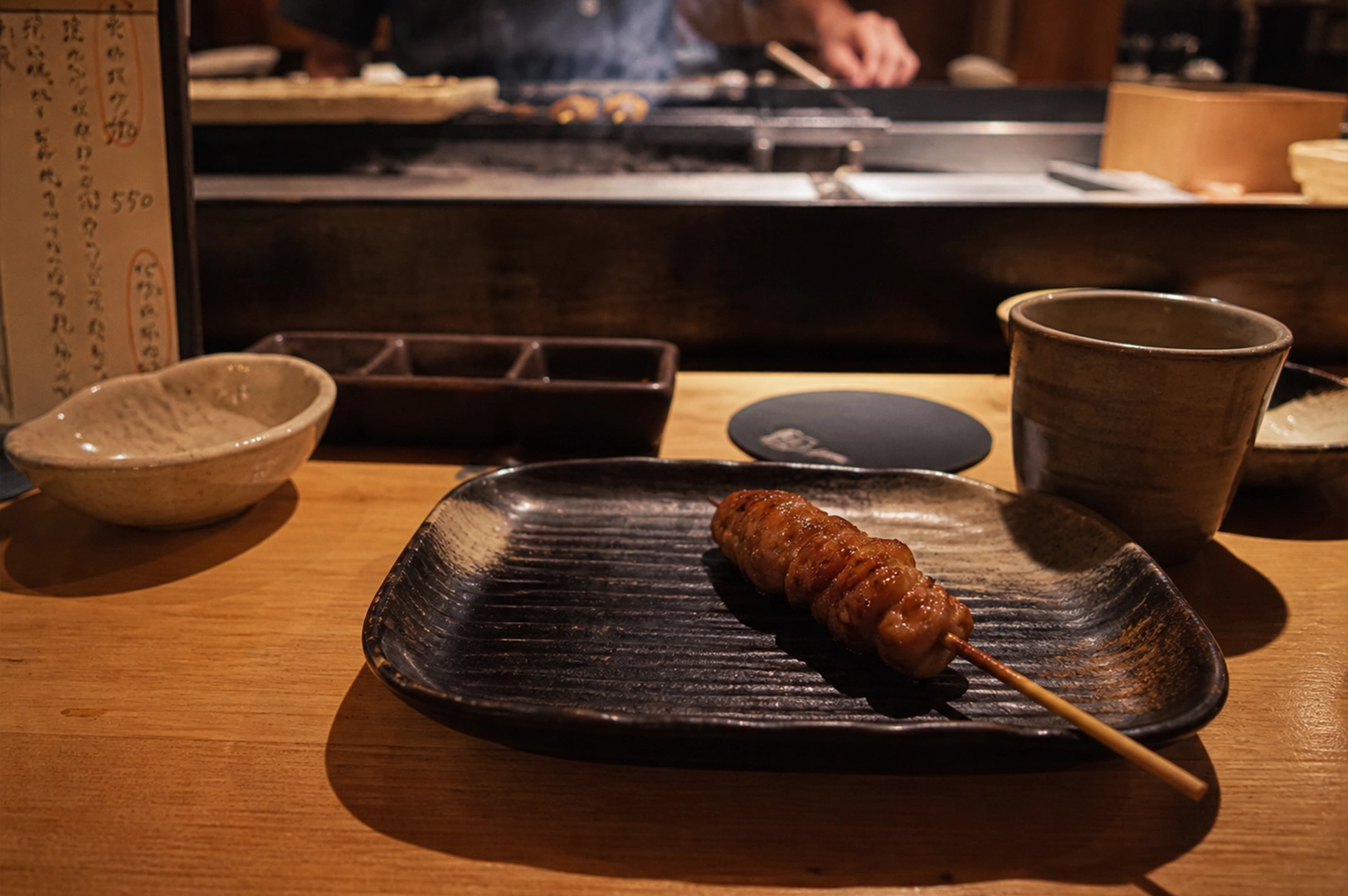
間の美しさ is something you begin to notice only after a few skewers. At first, you may focus on what arrives in front of you. But over time, it is the space in between that begins to feel just as important.
There is a natural pause after each skewer. Not empty, but gentle. You take a sip, you look toward the grill, you let the last bite settle. This is where yakitori quietly teaches you to slow down.
It can feel unfamiliar at first. Many meals are about continuity, about filling the table quickly. But here, the rhythm is different. Each piece is given its own moment. Nothing overlaps, and nothing competes.
If you watch closely, you will see how the chef respects this space as well. Skewers are not rushed out. There is always a small breath between them, allowing both fire and diner to reset.
You do not need to force the pause. It happens naturally when you begin to pay attention. Let your hands rest for a moment. Let the warmth fade slightly before the next arrives.
Somewhere along the way, you realise the meal is not only about eating. It is about pacing, about presence, about allowing each small moment to exist fully.
And in those quiet spaces, the experience becomes something more complete.